Governments and private companies are pouring billions into different approaches to fusion energy, with the same basic goal: recreate the process that powers the Sun and turn it into an inexpensive source of energy here on Earth. But bigger budgets do not necessarily mean faster progress.
In New Jersey, a small company called LPPFusion has spent years pursuing a very different path to fusion power. Its team is tiny, its total funding is modest by fusion-industry standards, and its experimental device can fit inside a room.
Yet the company has spent roughly $12 million while producing peer-reviewed plasma temperatures reaching 2 billion degrees Celsius, delivering notable fusion results at a fraction of the industry’s typical cost.
In an industry accustomed to billion-dollar numbers, that is worth looking at more closely.
Fusion Has Become a Very Expensive Race
There is no shortage of money chasing commercial fusion.
Private companies have raised billions, while national laboratories and international projects have spent considerably more developing experimental reactors, lasers, magnets and the supporting infrastructure needed to operate them. That spending is understandable.
Fusion is an extraordinarily difficult engineering problem. Researchers need to create the conditions in which atomic nuclei can overcome their natural repulsion and fuse. Those conditions involve extreme temperatures, sophisticated equipment and precise control of plasma. The question is whether those enormous machines are the only practical route.
LPPFusion does not think they are. The company has instead spent decades developing an approach called Focus Fusion, based on a device known as the Dense Plasma Focus, or DPF. And compared with the enormous facilities normally associated with fusion research, the Focus Fusion device is surprisingly small.
A Different Way of Thinking About Fusion
Most people who have seen photographs of experimental fusion reactors probably picture something enormous. Tokamaks, for example, use powerful magnetic fields to confine extremely hot plasma inside large toroidal chambers. Other approaches use lasers or alternative magnetic-confinement systems.
LPPFusion's approach is considerably more compact. Its Focus Fusion system is based on Dense Plasma Focus technology that dates back to research conducted in the 1950s. Instead of trying to control natural plasma instabilities, the company is attempting to use them to its advantage.

Top Left:The Dense Plasma Focus device (DPF) core of the LPPFusion generator design. Shown here:Cathode (the outer “teeth”) and anode with the insulator (white), the inner electrode.
Top Middle: The DPF - inside the chamber
See animation: How Focus Fusion Works
The electrodes at the core of the LPPFusion’s FF-2B device are only 10 inches across and go inside a 2-foot-long chamber. The device uses natural plasma instabilities to produce filaments (blue) that focus power into a tiny plasmoid (that’s the micro-” sun” in the lab). Fusion energy exits in an ion beam (red),an an electron beam and X-rays not visible here.
Top Right: The LPPFusion’s 5MW generator - artist’s concept. 5MW is enough to power 5,000 homes. (image by Torulf Greek)
Bottom Left: pB11 energy density comparison: 100 grams of hydrogen-boron (pB11) fuel has a theoretical energy content equivalent to roughly 76 tons of petroleum. This figure describes the energy potentially released by complete fusion of the fuel, not electricity that has been demonstrated in experiments.
Bottom Right: 100 grams of pB11 fuel and Sharpie pen
There is another important difference: pB11fuel.
LPPFusion is developing a pB11 fusion, an advanced process combining hydrogen and boron-11, where “p” is a proton from hydrogen and B-11 is the boron isotope. The intended fusion reaction produces millions of times more energy than oil or gas, and it produces only one byproduct: helium. The long-lived radioactive waste associated with conventional nuclear fission or with standard fusion approaches is not produced in pB11 fusion reactions. The primary pB11 reaction is aneutronic, meaning it does not produce neutrons directly. However, secondary reactions in the plasma can produce a small number of neutrons and short-lived radioactive byproducts such as carbon-11 (half-life ~20 minutes). While the neutron yield is far lower than in deuterium-tritium fusion or nuclear fission, it is not zero. LPPFusion's own published research acknowledges these secondary reactions.
Is pB11 Fusion Fuel The New Oil?
Aside from being aneutronic, the pB11 fuel is disruptive for one more reason - it has an incredibly high energy density: just 100 grams of pB11 has a theoretical energy content equivalent to roughly 76 tons of petroleum - by fusing (nuclear reaction), not burning (chemical reaction) it. Realizing that energy as usable electricity remains an engineering challenge that has not yet been demonstrated at scale. Numbers like that explain why fusion continues attracting enormous amounts of capital despite the technical difficulty.
An important detail to keep in mind is that LPPFusion proposes that its generators using hydrogen-boron fuel could convert fusion energy directly into electricity, which would eliminate the need for expensive steam generators and turbines and could significantly reduce the cost of electric power. This proposed approach relies on the predominantly aneutronic nature of pB11 fusion reactions. These outcomes require further experimental validation. In case of any disturbance of fusion conditions, the system stops reacting, removing any chance of the runaway chain-reaction scenario commonly associated with older nuclear fission plant meltdowns. That makes the theoretical safety profile compelling.
There are potential economic advantages too.
If the physics works at the scale LPPFusion anticipates, commercial fusion generators would not require the long-distance transmission lines associated with legacy energy infrastructure. Decentralized energy supply is part of LPPFusion’s vision for the near future - a design that could resolve both: an obsolete electrical grid and messy fossil fuel supply issues.
If these properties are confirmed at commercial scale, they could make LPPFusion's approach both safer and more cost-effective than alternatives. On paper, it is an attractive version of fusion. Getting it to work is the difficult part.
The Numbers Behind LPPFusion's Argument
This is where LPPFusion's story becomes particularly interesting.
The company says its experiments have reached confined plasma temperatures of approximately 2 billion degrees Celsius. Its results have also appeared in peer-reviewed publications including Physics of Plasmas and the Journal of Fusion Energy. For a company of its size, publishing matters.
Fusion is full of ambitious targets, proposed reactors and projected timelines. Experimental data that other scientists can inspect provides something considerably more useful than another rendering of what a future power plant might look like.
LPPFusion also makes an unusually aggressive argument about efficiency. Based on published experimental results using deuterium fuel, the company says its output-to-input energy ratio, referred to as the Wall-Plug Efficiency in the industry, substantially exceeds those published by private competitors including TAE Technologies and MIFTI.
Those comparisons should be treated carefully because fusion companies are pursuing different reactor designs, fuels and experimental objectives. Comparing individual experiments does not automatically tell us which company will ultimately build the first commercially viable reactor. Still, LPPFusion's underlying point is difficult to ignore.
It has been conducting fusion research with millions while much of the industry operates in billions.
$12 Million Changes the Conversation
Cost is not usually the exciting part of fusion research, but perhaps it should be.
A technology can work brilliantly in a laboratory and still fail as an energy source if the machinery required to produce that energy is too expensive to build, operate and maintain.
That is one reason LPPFusion's relatively small budget deserves attention. The company says it has spent approximately $12 million across its development. For comparison, some private fusion companies have raised well above $1 billion, while major government-backed experiments have required multibillion-dollar investments.
That does not prove LPPFusion has found the better route. Does it raise a worthwhile question: How much infrastructure do we actually need to make fusion work? LPPFusion's answer is essentially: much less than everyone assumes.
And the company's structure seems to reflect the same philosophy.
The Five-Person Fusion Company
LPPFusion's core operations team is remarkably small.

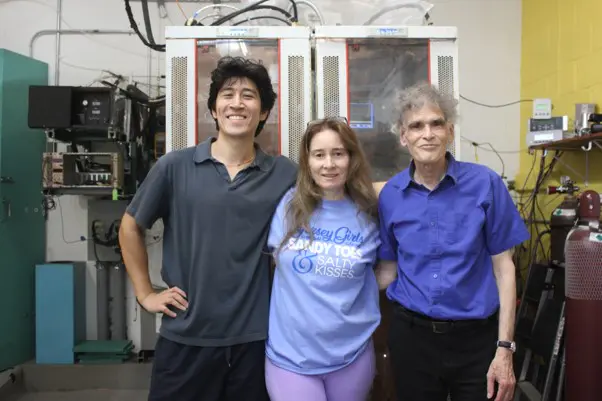
Chief Scientist and President Eric Lerner leads its scientific work. Research scientist Dr. Syed Hassan focuses on experimental operations and plasma diagnostics. Rudolph Fritsch works on device engineering, while Sam Grund works across research and operations. The core team is aided by part-time but enthusiastic contractors spread around the world, such as Dr. Warwick Dumas in the UK, who develops simulations.
Then there is Ivy Karamitsos, co-founder and COO, whoturned what had been Lawrenceville Plasma Physics into LPPFusion, rebuilding the company's brand while managing its financial, operational, investor and IT infrastructure.
That division of labour has become part of how the company describes itself. Lerner handles much of the core research. Karamitsos keeps the business around the fusion research functioning. Experiments need funding. Financial audits need completing. Equipment needs sourcing. Research needs coordination. Investors need updates. Someone has to keep the lights on so that a visionary can recreate the conditions inside a star.
Why LPPFusion Said No to Traditional Venture Capital
Perhaps the more unusual part of the LPPFusion story is not its reactor. It is how the company has chosen to fund it.
Rather than building itself primarily around institutional venture capital, LPPFusion has relied heavily on community funding. The company says thousands of investors across 19 countries have supported its work. It also says it has rejected wealthy investors who wanted control of the technology.
That decision has obvious disadvantages. Fusion experiments cost money, and refusing large cheques makes an already difficult technical challenge even harder. But LPPFusion argues that ownership matters when the technology being developed could eventually become part of the world's energy infrastructure.
Karamitsos puts the argument more strongly.
“We turned down venture capitalists who wanted control. We turned down billionaires. Every single time,” she says. LPPFusion’s concern is that giving a controlling investor power over the company could eventually give that investor power over the direction-or even continuation-of its research.
Whether community funding can carry a fusion company all the way through commercialization remains another question. But it has carried LPPFusion remarkably far.
Small Science Research Still Needs Serious Money
There is a romantic version of this story where five people in New Jersey quietly beat multibillion-dollar laboratories at their own game.
Reality is more complicated. Reaching extreme plasma temperatures is not the same thing as operating a commercial power plant. Neither are impressive experimental yields. Fusion ultimately has to cross a much more unforgiving threshold: producing useful energy economically and reliably.
LPPFusion's next major objective is net energy, where the fusion process produces more energy than the system puts into it. The company expects its hydrogen-boron experiments to move it closer to answering that question. If it succeeds, the conversation around LPPFusion changes considerably. If it does not, its existing work still offers useful experimental data for an industry testing several competing approaches to the same enormous problem.
That is the nature of frontier science. Not every promising experiment turns into lasting infrastructure, but in both science and life, ruling out a path is just as critical as finding the right one-until proven wrong, of course.
What Happens If the Small Approach Works?
This is ultimately what makes LPPFusion worth watching.
The company is not simply trying to build another fusion reactor. It is making a bet about what fusion infrastructure needs to look like. If fusion requires enormous centralised facilities costing billions of dollars each, its eventual role in the energy system may resemble today's large nuclear plants. If something closer to Focus Fusion proves practical, the economics could look very different.
If smaller reactors prove viable, they could potentially allow power generation to become more decentralized. Under LPPFusion's proposed model, fusion generators could be built closer to the communities and industries they serve, reducing reliance on large centralised plants, long-distance transmission lines and fossil fuel supply chains. These projections remain contingent on achieving net energy and demonstrating commercial feasibility.
There is still a substantial distance between that idea and commercial deployment. LPPFusion's own roadmap places a working commercial prototype after its net-energy milestone, with broader deployment coming later. Those dates should be viewed as targets rather than guarantees. Fusion has a long history of reminding researchers that physics does not particularly care about business timelines.
Still, the underlying experiment is fascinating.
Fusion May Need More Than One Big Idea
Many Paths, One Dream: Affordable Fusion Energy
The fusion race is often discussed as though there will eventually be one winner.
Science rarely works that neatly.
Different reactor architectures may ultimately prove useful for different applications. Some approaches may fail completely. Others may contribute materials, plasma research or engineering techniques that help competing systems succeed. What matters now is keeping enough credible approaches alive long enough to find out.
LPPFusion represents one of the more unconventional ones. It has a tiny team, a relatively tiny budget and a technology based on a device whose roots stretch back more than half a century.
Yet it has continued producing experiments and publishing results. The company continues working toward its next major scientific milestone. The billions pouring into fusion tell us investors increasingly believe the technology could become important.
Transistors, airplanes, the WWW and the human genome were all figured out by tiny teams and budgets. LPPFusion asks a more interesting question: What if getting there doesn't require billions?